 By Mark WhiteOwner & Executive Producer, DFW Live Stream
A freelance videographer and a livestream production company are not the same purchase, even when the two quotes land in the same neighborhood. Here's the short version: a freelancer sells you a person with gear. A production company sells you a system with backups, plus somebody whose entire job that day is making sure the stream doesn't stop. If your event is recoverable — you could re-record it, reschedule it, or shrug it off — a good freelancer is often the smarter, cheaper call. If it happens once, in front of people who matter, with no second take, you're buying redundancy. That's what a production company is.
I've worked both sides of this. I've shot solo with a camera on my shoulder, and I've run a production desk with a crew of four. The thing people get wrong is that they frame it as a skill question. It usually isn't — plenty of freelancers are excellent operators. It's a question of what happens at 9:14 a.m. when something dies with 400 people watching.
A freelancer is one skilled person doing every job at once. That's not a knock — it's just the physics of one set of hands.
On a typical solo livestream job, that one person is framing the camera, riding the audio, watching the encoder, monitoring the stream health, fixing the laptop when it hiccups, and answering the client's questions about when the recording will be ready. Every one of those is a real job. When all six are stacked on one person, they get done in priority order, and the ones at the bottom of the list get done late or not at all.
Where this works beautifully: a single-camera talk, a recurring internal meeting, a podcast-style interview, a training session that gets recorded anyway, an event where the stream is a nice-to-have rather than the point. In those cases you're paying for competence, not insurance, and paying twice as much for insurance you'll never use is a bad trade.
Where it falls apart: the moment the event has a second camera, a hybrid audience, a house audio system you don't control, or an executive who will be very unhappy if the feed drops.
A production company sells capacity and redundancy — more hands, more gear, and a second version of everything that can fail. The individual skill level might be identical to your freelancer's. The failure tolerance is not.
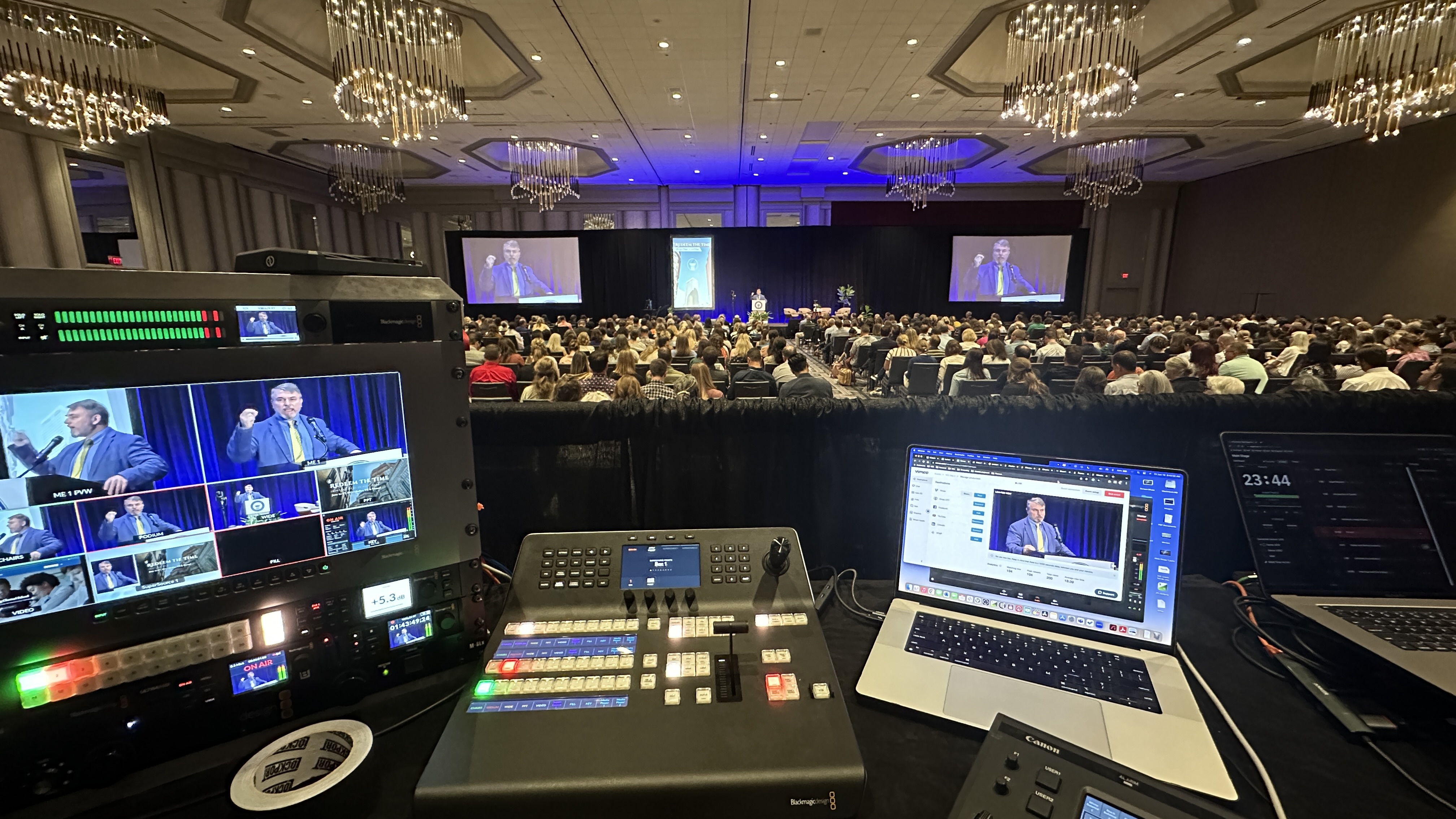
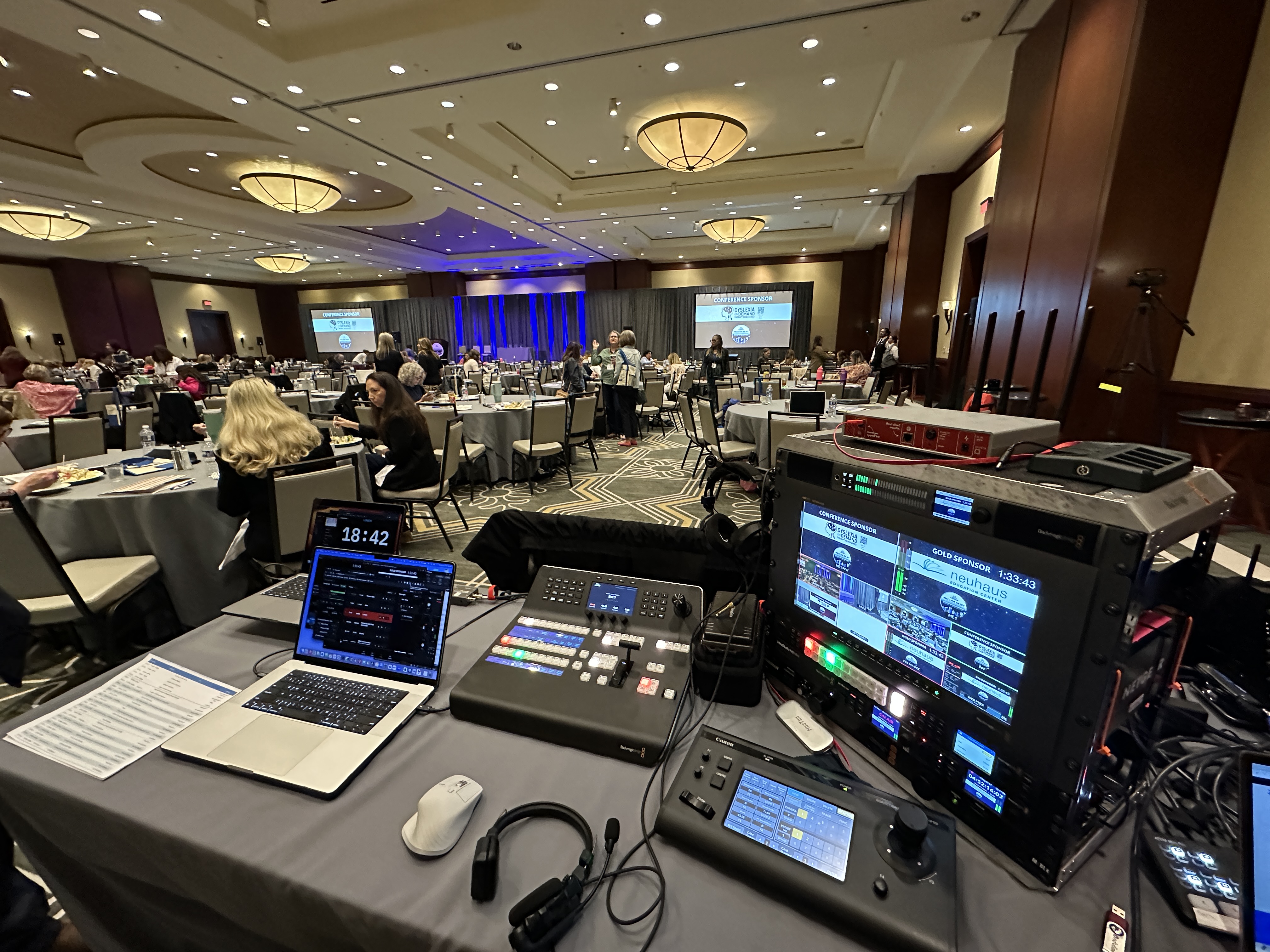
On our jobs that means a dedicated switcher operator on the Blackmagic ATEM who isn't also holding a camera, a separate audio path off an Allen & Heath SQ5 instead of a mic taped to a camera, and a bonded cellular encoder like a LiveU Solo Pro sitting behind the venue's WiFi in case the venue's WiFi does what venue WiFi does. It also means a person who can walk away from the desk to chase down a dead lav battery without the stream going to black.
There's an operational layer too that freelancers rarely include: a rehearsal the day before or the morning of, a run of show reviewed with your team, a labeled signal path so any crew member can troubleshoot it, and a plan for what happens if the primary internet connection drops mid-keynote. We wrote up the common failure modes in why corporate livestreams fail — almost every item on that list is a redundancy problem, not a talent problem.
Forget cameras and resolutions for a second. Ask one question: if the single most important piece of equipment fails at the worst possible moment, what happens next? The answer tells you which vendor you need.
With one person and one of everything, the answer is "the stream stops while they fix it," and the fix takes as long as it takes. With a crew and a duplicated signal chain, the answer is "we cut to the backup and most people never notice." That gap — between a visible outage and an invisible one — is most of the price difference between the two options.
Some events genuinely don't need that. A weekly all-hands where the recording gets posted afterward can survive four minutes of black. A shareholder meeting, a product launch with press on the line, or a ticketed virtual conference cannot.
Freelance solo operators in the DFW market typically land somewhere in the high hundreds to low thousands for a half or full day, depending on gear and experience. Production companies start higher because there's more of everything — more crew, more equipment, more prep.
For us, a full-virtual event run by a single operator generally starts around $1,595, and in-person work starts around $3,900. Multi-camera and hybrid events usually run $5,000 to $15,000 depending on scope, and multi-day conferences typically land in the $11,000 to $30,000 range. Add a setup and rehearsal day and you're generally looking at another $2,250 to $3,750. Those aren't rate-card numbers — every event gets priced on what it actually takes — but they'll tell you fast whether you're in the right aisle.
The mistake I see most often is comparing a freelancer's day rate to a production company's project total and concluding the company is three times more expensive. It isn't three times the same thing. It's a different scope. If you want an apples-to-apples read, ask both vendors to price the identical deliverable: this many cameras, this audio source, this platform, this backup plan, this recording turnaround. We broke the components down in what's included in a corporate livestream package, and there's a fuller cost picture in how much it costs to livestream an event.
After a few hundred of these, the split is pretty predictable. It comes down to camera count, audio complexity, and how much it costs you if the stream fails.
A freelancer is usually the right call when: one camera covers it, the audio comes from a simple source you control, the audience is internal, the event repeats, and a recording would be an acceptable outcome if the live feed hiccuped.
You want a production company when: you need two or more angles, you're pulling audio from a venue's mixing console, there's an in-room audience and a remote audience to serve at the same time, graphics and lower thirds are part of the deal, the event is externally facing, or a failure would cost you real money or credibility. If you're weighing camera count specifically, multi-camera live production covers what changes when you add the second angle.
Hybrid events break the freelancer model faster than anything else, because a hybrid event is really two events sharing a room. Somebody has to serve the people in the seats and somebody has to serve the people at home, and those two audiences want different things.
The in-room audience needs house audio, screens they can read, and a program that flows. The remote audience needs clean audio without room echo, tight framing so faces are legible on a laptop, a chat or Q&A someone is actually monitoring, and a stream that doesn't buffer. One person cannot serve both well at the same time, and the remote audience is the one that quietly loses. That's the whole argument in hybrid event best practices — the remote side needs its own advocate in the room.
You don't need to be technical to tell these two apart on a call. Four questions do most of the work.
"What's your backup if the venue internet drops?" You want a specific answer — a bonded cellular encoder, a second ISP path, a hotspot with a tested failover. "We'd figure it out" means there is no backup.
"How many people will be on site, and what does each one do?" If the answer is one person and the event has three cameras, somebody is about to be very busy.
"Do you rehearse?" Rehearsal is where you find out the venue's audio feed is mono, the HDMI output is 1080i, and the presenter's slides are 4:3. Finding that out during the event is a different experience.
"Where does audio come from?" Audio is the single biggest driver of whether a stream feels professional, and it's the thing solo operators compromise on first. We went deep on this in getting your livestream audio right.
This isn't binary, and the best-run programs I see treat it as a portfolio. Use the expensive option where the stakes are, use the cheap option everywhere else.
A lot of our clients bring us in for the annual conference, the investor meeting, and the two big external launches, then run their monthly internal webinars with a freelancer or their own in-house setup. That's a smart allocation. You don't need a four-person crew for a Tuesday lunch-and-learn, and you don't want a solo operator on your biggest day of the year. If you're weighing the in-house option too, livestream company vs. DIY streaming works through that side of it.
Write down three things: how many cameras the event needs, where the audio is coming from, and what it costs your organization if the stream goes down for ten minutes. Those three answers will pick the vendor for you.
If it's one camera, simple audio, and the honest answer to the third question is "not much," hire a good freelancer and don't overthink it. If it's two or more cameras, venue audio, or a number with a comma in it on that third question, you want a company. And if you land somewhere in between — which is where most events actually sit — that's the conversation worth having out loud with a vendor before anyone sends a quote.
If you're stuck in that middle, grab 20 minutes with me and we'll talk it through. I'll tell you honestly if your event doesn't need us — I'd rather point you toward the right-sized option than sell you crew you won't use. Book a time here, no pressure and no pitch.
No. For a single-camera internal meeting or a recurring training session, a good freelancer delivers the same result for less money. A production company earns its price when the event has multiple cameras, venue audio, a hybrid audience, or real consequences if the feed drops.
It varies by scope, but expect a meaningful multiple rather than a small premium — you're paying for additional crew and duplicated equipment. Full-virtual work with a single operator generally starts around $1,595 and in-person events start around $3,900, with multi-camera and hybrid productions typically running $5,000 to $15,000.
They can, with PTZ cameras and a switcher, and we do it ourselves on smaller jobs. The limitation isn't the switching — it's that the same person is also handling audio, encoding, and anything that goes wrong. It works until something needs attention in two places at once.
Audio, almost every time. Solo setups often pull sound from a camera mic or a single feed with no backup, and viewers forgive bad video far more readily than bad audio. A dedicated audio path off the venue's console is usually the most noticeable upgrade.
For anything externally facing, yes. Rehearsal is where you discover the venue's audio feed, the resolution of the presentation output, and whether the internet holds under load. A setup and rehearsal day typically adds $2,250 to $3,750 and removes most of the ways an event goes sideways.
Venue name, date, run time, how many speakers and where they'll be, where the audio comes from, whether there's an in-room audience, what platform you're streaming to, and what you need afterward. That's enough for a real number instead of a range.
Four to six weeks is comfortable for most single-day events, longer if it's a multi-day conference or falls in a busy season like spring and fall. Shorter timelines are usually doable, but they limit crew and gear availability.
Yes, and plenty of clients do exactly that. It's common to bring a crew in for the keynote days or the externally facing sessions and handle the smaller breakouts with a freelancer or an internal team.
Mark runs DFW Live Stream and has been producing corporate livestreams, conferences, town halls and webinars across Dallas–Fort Worth and around the country since 2017. He writes these from the production desk, not a marketing department, and uses AI tools to help draft and structure them. Every post is read, fact-checked and edited by him before it goes live.