Here's the short version: a virtual event production company handles everything between your speakers and your online audience — the cameras, the switching, the audio, the platform, the graphics, the rehearsals, and the troubleshooting — so your event looks like a broadcast instead of a video call. You bring the content and the audience. We make it look and sound like it mattered.
I'm Mark, and our team produces virtual and hybrid events for companies across Dallas-Fort Worth and beyond. In this post I'll walk through exactly what a virtual event production company does, what you should expect to pay, and how to tell whether your event actually needs one.
Virtual event production is the full technical and creative execution of an event that happens online — town halls, product launches, virtual conferences, investor meetings, training summits. It covers everything from pre-production planning through the moment the stream ends.
That's a broad definition, so here's what it looks like in practice. A production company plans the run of show with you, builds the visual package (lower thirds, slides, countdowns, sponsor loops), manages remote and in-studio presenters, mixes the audio, switches between cameras and screen shares in real time, pushes the stream to your platform, and monitors everything live. When something goes sideways — and something always tries to — there's a professional already fixing it before your audience notices.
The biggest misconception I run into: "we already have Teams, so we're covered." A meeting platform and a produced virtual event solve different problems. Meetings are for collaboration between participants. Events are for delivering a message to an audience.
When your CEO addresses 800 employees, nobody needs to see 799 muted webcam tiles. They need a clean program feed: the speaker framed well, slides integrated properly, smooth transitions, and audio that doesn't clip or echo. That's the difference between a meeting and a broadcast, and it's why companies that run their quarterly all-hands as a raw video call tend to see attendance quietly drop off. If you want to understand what separates events that hold an audience from ones that lose them, I broke that down in why corporate livestreams fail.
Most of the value a production company delivers happens before anyone goes live. Pre-production is typically 70 percent of the work, and it's the part that makes event day feel calm instead of chaotic.
Before the event, we build a run of show with timings for every segment. We test every remote presenter's camera, mic, lighting, and internet — individually, days ahead. We prep graphics and pre-recorded segments so they roll cleanly. We set up redundant internet and backup recordings. And we run a full rehearsal, because rehearsed events succeed and unrehearsed events gamble. Our team treats the rehearsal as non-negotiable, and it's saved more events than any piece of gear we own.
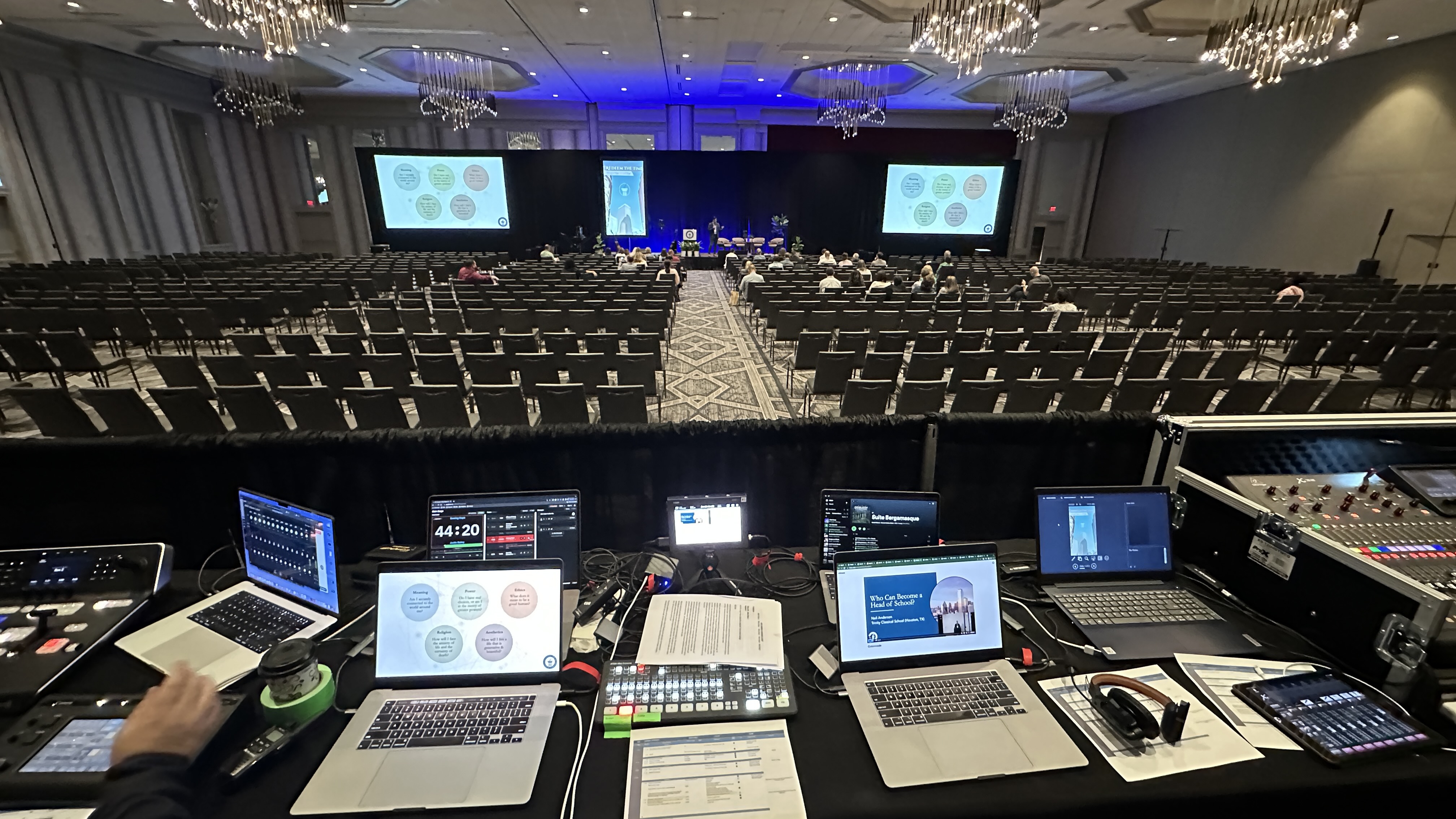
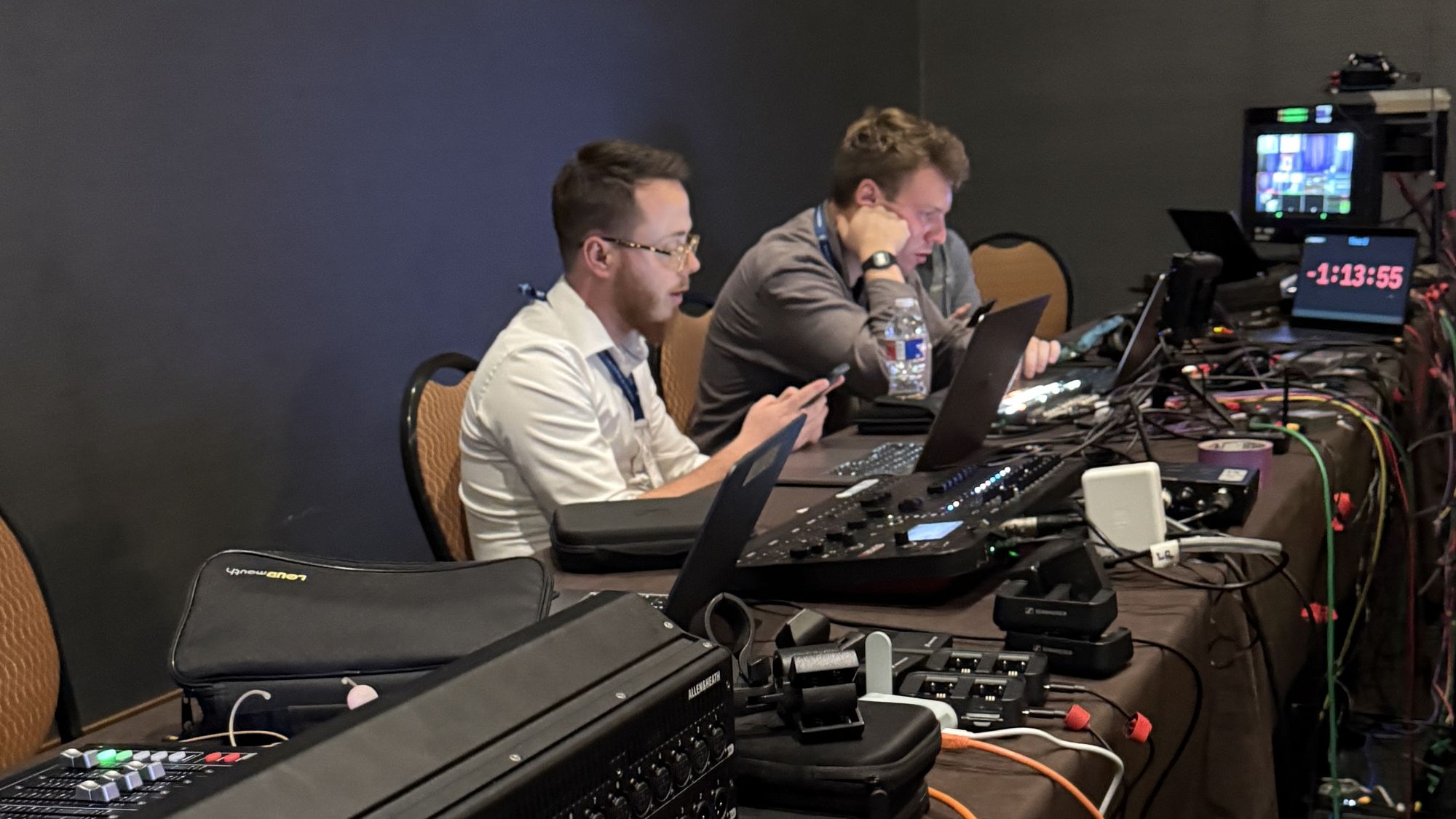
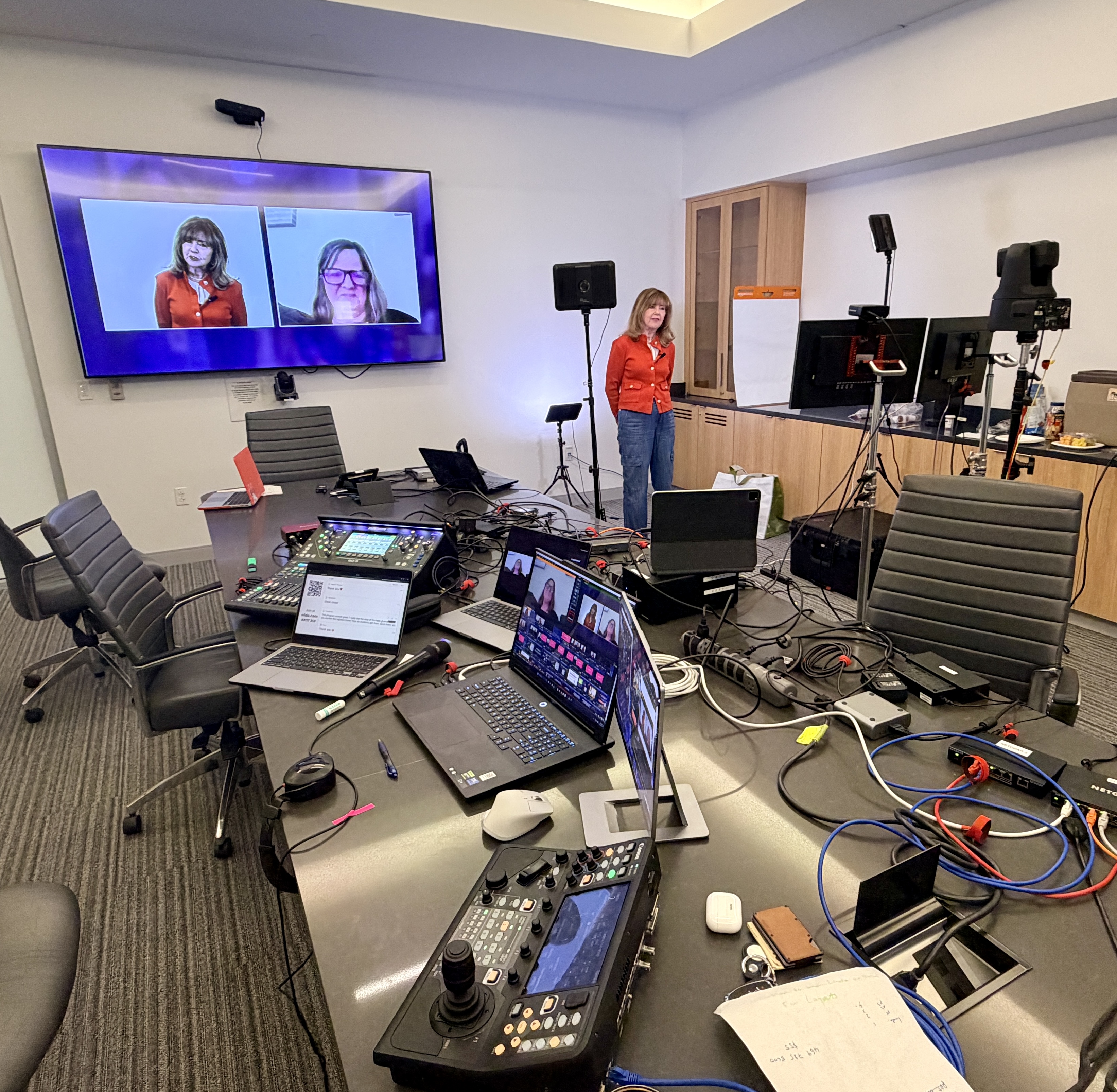
On the day, a produced virtual event runs like a small TV broadcast. There's a technical director switching sources, an audio engineer riding levels, and someone managing remote presenters in a green room before they go on. Speakers get countdowns and cues so they're never surprised.
The audience sees one polished program feed: wide shot, close-up, slides picture-in-picture, name graphics as each speaker appears. Behind that feed, the crew is watching return monitors, stream health dashboards, and chat moderation. If a presenter's internet drops, we cut to a holding slide, get them back in, and most viewers never know. That composure under pressure is fundamentally what you're hiring.
You don't need to care about gear the way we do, but it helps to know what a professional setup involves, because it explains the difference in output quality. On a typical virtual production we're running Canon CR-N500 PTZ cameras that can be reframed remotely mid-show, a Blackmagic ATEM switcher mixing every source, Sennheiser wireless microphones on presenters, and an Allen & Heath SQ5 console handling the audio mix. When we're producing from a venue with questionable internet, a LiveU Solo Pro bonded cellular encoder keeps the stream alive even if the building's network fails.
On the platform side, a good production company is platform-agnostic. We've delivered events into Zoom Webinars, Teams Live Events, YouTube, Vimeo, and private corporate portals. The production layer sits upstream of the platform, which means you can keep the platform your IT team already approved and still get broadcast-quality output through it.
Pricing depends on scope, but the ranges are fairly predictable. A single-operator, full-virtual production — one professional managing remote speakers, graphics, and the stream — typically starts around $1,595. Multi-camera productions and hybrid events, where you have an in-person audience plus a virtual one, generally run $5,000 to $15,000 depending on cameras, crew, and complexity. Multi-day virtual conferences with concurrent sessions typically land in the $11,000 to $30,000+ range.
If your event has enough moving pieces that a separate setup and testing day makes sense, that's usually around $2,250 to $3,750. For a deeper breakdown of what drives those numbers, see my full guide on what it costs to livestream an event and what's included in a corporate livestream package.
The honest answer comes down to stakes and intent, not headcount. If the event carries real consequences — leadership credibility, revenue, investor confidence, a paying audience — professional production earns its fee. If it's a casual internal sync, your meeting platform is probably fine.
Think about it this way: what does it cost you if the event goes badly? A glitchy product launch doesn't just lose viewers in the moment; it shapes how customers perceive the product. An all-hands with broken audio tells employees the message wasn't worth preparing for. Companies generally hire us when the answer to "what if it fails?" is expensive, embarrassing, or both.
Many "virtual" events are really hybrid events in disguise — a boardroom of executives plus hundreds of remote viewers, or a conference with in-person attendance and a virtual ticket tier. Hybrid raises the production stakes because you're serving two audiences with different needs at the same time. The remote audience needs dedicated camera coverage and a produced feed, not a camera pointed at a projector screen.
If that's the direction your event is heading, start with my guide to hybrid event best practices — it covers the decisions that matter before you book anything.
Ask three things. First, ask to see full-length recordings of past virtual events, not sizzle reels — anyone can cut 60 good seconds. Second, ask how they handle presenter tech checks and rehearsals; if there isn't a clear process, keep looking. Third, ask what happens when something fails mid-event. A real production company will immediately start talking about redundant internet, backup recordings, and contingency cues, because they've lived it.
And expect a real discovery conversation. A good partner asks about your audience, your goals, and your content before they quote anything. If you want a preview of how that process works with us, here's what to expect when you hire a livestream company.
Planning a virtual event and want a second set of eyes on it? Grab 20 minutes with me — no pitch, just a straight answer on what your event actually needs and roughly what it should cost.
It handles the complete technical execution of an online event — cameras, switching, audio, graphics, presenter management, streaming, and live monitoring. The goal is a broadcast-quality program feed instead of a raw video call, so your audience stays engaged and your team can focus on content.
Single-operator full-virtual productions typically start around $1,595. Multi-camera and hybrid events generally run $5,000 to $15,000, and multi-day virtual conferences typically range from $11,000 to $30,000 or more depending on scope.
You can, and for routine meetings you should. A production company adds value when the event needs to look intentional — polished switching, integrated graphics, managed presenters, and someone accountable for stream health. The platform stays the same; the quality of what flows through it changes.
For a standard virtual event, two to four weeks gives enough runway for planning and rehearsal. Larger virtual conferences benefit from six to eight weeks. We've turned events around faster, but rehearsal time is the first thing a rushed timeline squeezes, and it's the last thing you want to lose.
Usually not. We tech-check every presenter in advance and optimize what they already have — camera position, lighting, mic choice, and internet. When a speaker is high-stakes, we can ship a kit or arrange a local camera operator, but most executives present well with guided setup.
Virtual means the entire audience attends online. Hybrid means you have an in-person audience and an online one simultaneously, which requires serving both — room AV and IMAG for the people in the seats, plus a dedicated produced feed for remote viewers.
That's exactly what redundancy planning is for. We run backup internet paths — including bonded cellular encoders that don't depend on the venue's network — plus local recordings of the full program, so the event survives even when a connection doesn't.
Almost always, yes. We produce the program feed upstream and deliver it into whatever platform your organization uses — Zoom, Teams, YouTube, Vimeo, or a private portal — so IT approvals and registration workflows stay untouched.