 By Mark WhiteOwner & Executive Producer, DFW Live Stream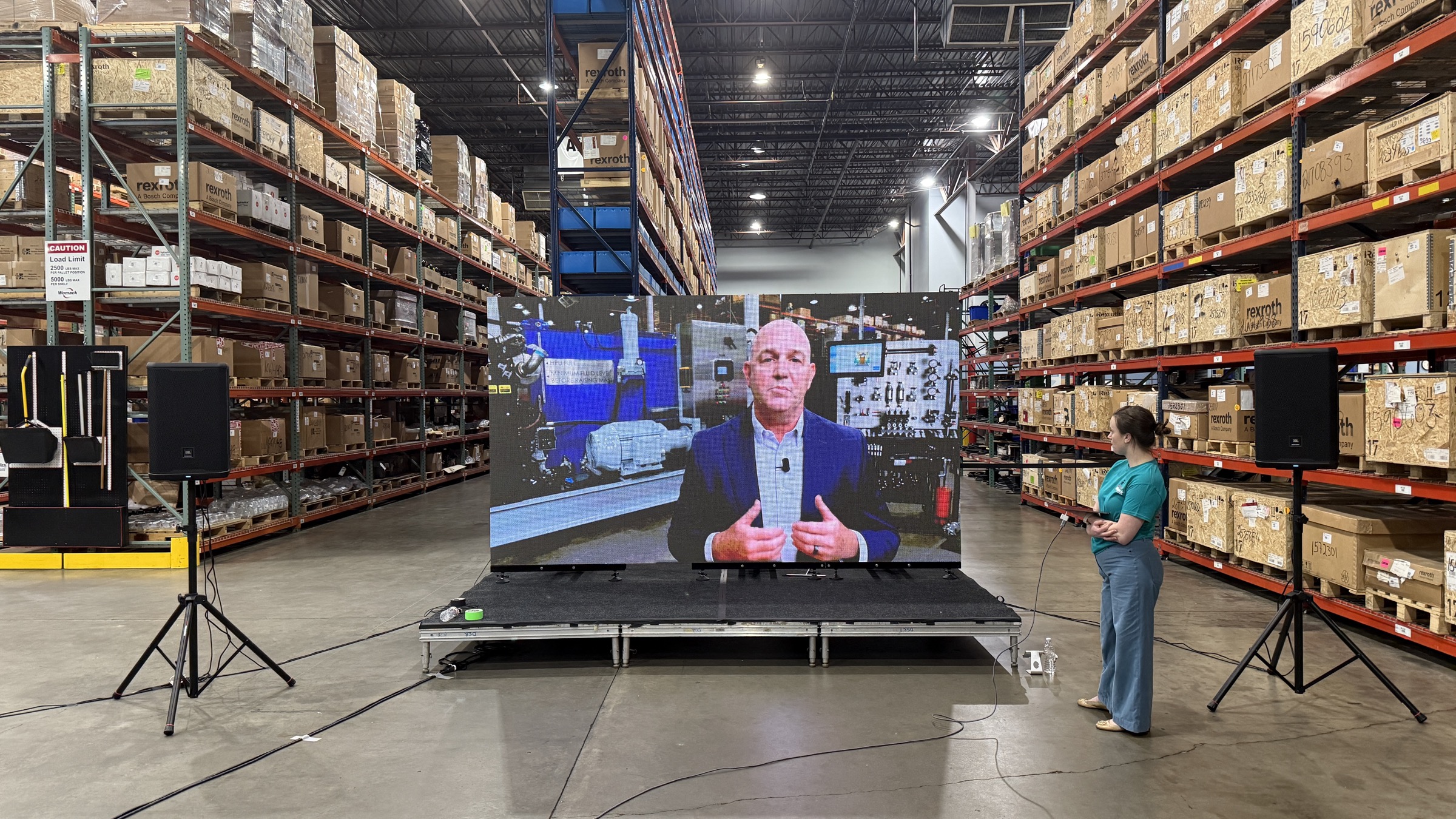
Once you've decided your event needs a big screen, the next question lands fast: LED wall or projector? I've produced events in Dallas-Fort Worth with both, and the right answer depends on your room, your budget, and — if you're livestreaming — how the screen behaves on camera.
The short answer: LED walls win on brightness, visual impact, and how they look on camera. Projectors win on cost and simplicity. If your event is in a bright space, has a big audience, or is being filmed or streamed, the LED wall is usually worth the premium. If you're in a dimmable ballroom showing mostly slides to an in-person audience, a good projector does the job for a fraction of the price.
A projector throws light onto a passive screen, which means everything about its performance depends on the light in the room. The image is only as good as the darkness around it.
An LED wall is the opposite: it doesn't reflect light, it emits it. The wall is built from individual panels tiled together into whatever size the stage needs, and each panel is packed with tiny LEDs that produce the image directly. That single difference — reflected light versus emitted light — drives almost every practical tradeoff between the two.
This is the question that settles most debates: can you control the light in your room? If the answer is no, the projector conversation is basically over.
Projected images wash out under ambient light. In a venue with big windows, an atrium, an outdoor stage, or house lights that need to stay up for note-taking or cameras, a projector turns pale and washed out no matter how many lumens you rent. LED walls stay punchy and saturated in full daylight — it's why every outdoor concert and car dealership uses them. If your event is in a typical hotel ballroom where lighting can be dimmed near the screen, a projector still performs well. If you're in a bright modern space with floor-to-ceiling glass, go LED and don't look back.
If your event is being livestreamed or filmed, the screen isn't just for the room — it's part of your broadcast set. This is where LED walls really separate themselves.
A camera exposes for people's faces, and a projection screen behind a properly lit speaker almost always reads as dim and washed out on the stream. You end up choosing between a well-lit presenter and a visible screen. An LED wall solves that: it's bright enough to hold its own against stage lighting, so the speaker and the content both look right in the same shot. There are technical details to manage — camera shutter speed has to be matched to the wall's refresh rate to avoid flicker or scan lines, and very fine pixel pitch matters if cameras will shoot the wall close up — but those are solvable problems a good crew handles in soundcheck. Whether you need screens at all is a separate question, and I covered it in do you need big screens at your event? IMAG explained.
There's no way around it: LED is the premium option. A projector and screen package for a ballroom presentation typically rents for a few hundred to a couple thousand dollars depending on brightness and screen size. LED walls are generally priced per panel, and a stage-sized wall with rigging, processing, and a technician typically starts in the low five figures.
That gap narrows when you factor in what the LED wall replaces — drape, scenic backdrops, extra lighting to compensate for a dim projector — but it rarely closes completely. My advice: price both against what the event is worth, not against each other. A sales kickoff or investor meeting that lives on video justifies LED; a quarterly all-hands in a dark ballroom usually doesn't need it. For context on how display choices fit into the bigger production budget, here's what it costs to livestream an event — full hybrid productions generally run $5,000–$15,000 before staging and displays.
Projectors need one thing venues don't always have: distance. A big image requires throw distance (or an expensive short-throw lens), plus a clear sightline that nobody walks through. Rear projection looks cleaner but eats ten or more feet of backstage depth.
LED walls need structure and power. Panels are heavy in aggregate, so they're either ground-stacked on a base or flown from rigging points, and the wall needs processing gear and a dedicated tech for the build. Load-in takes longer than a projector by hours, not minutes. Before committing to either, make sure your room can support it — ceiling height, rigging, power, and backstage space all matter, and I covered those basics in what your venue needs for a livestream.
Projectors remain the workhorse of corporate AV for good reason. In a controlled ballroom with dimmable lighting, a bright projector on a properly sized screen looks clean, professional, and costs dramatically less than LED.
Choose projection when the content is mostly slides and video support rather than scenic wow-factor, when the room lets you control ambient light, when budget matters more than sizzle, and when the in-person audience is the priority over cameras. Two projectors with matched screens flanking a stage is still one of the most cost-effective ways to make a mid-size corporate event feel polished.
An LED wall stops being a luxury and becomes the practical choice in a few specific situations. Bright venues top the list — atriums, glass-walled offices, warehouses, outdoor stages — because no projector fights daylight and wins.
It's also the right call when the event is camera-first: town halls broadcast to thousands of remote employees, product launches that live on as marketing video, or awards shows and galas where the screen is part of the stage design. And for hybrid events where remote attendees matter as much as the room, the LED wall keeps your stage looking intentional on camera — a big piece of the hybrid event best practices playbook.
Start with two questions: can you control the room's light, and will cameras be on the stage? If you can dim the room and the event is primarily for the people in it, rent a good projector and put the savings into audio and lighting — those affect the experience more than the screen technology does.
If the room is bright, the audience is large, or the event is being streamed or filmed, budget for LED. On camera, the difference isn't subtle, and if the recording is going in front of customers or executives, it's the piece of staging your video team will thank you for. Either way, get your display vendor and your video crew talking early — screen placement, content resolution, and camera positions all interact, and a 30-minute conversation in pre-production prevents most day-of surprises.
If you're weighing this decision for a specific event and want an honest read on which way to go — including whether you need a big screen at all — grab 20 minutes with me. I'll tell you what I'd do in your room, even if the answer is the cheaper option.
Almost always, yes. LED walls are bright enough to expose properly alongside a lit presenter, so both look good in the same camera shot. Projection screens typically read dim and washed out on camera unless you compromise your stage lighting.
It depends on size, pixel pitch, and labor, but stage-sized walls with rigging, processing, and a technician generally start in the low five figures for a one-day corporate event. Smaller ground-stacked walls can come in under that.
Pixel pitch is the distance between LEDs on the panel, measured in millimeters. Smaller pitch means a sharper image up close — important if cameras will shoot the wall tight or the audience sits near the stage. Larger pitch is fine when viewers are farther back, and it costs less.
Not well. Even high-brightness projectors wash out under significant ambient light, and adding lumens gets expensive fast. If you can't control the light near the screen, an LED wall or large LCD displays are the more reliable choice.
Projectors need throw distance and clean sightlines, or backstage depth for rear projection. LED walls need floor space or rigging for the panels, power, and several hours of build time. Neither is plug-and-play at stage scale, so share your room specs with your vendor early.
You provide the slides and videos; the production team handles formatting, resolution mapping, and switching. With LED walls especially, content should be built to the wall's exact pixel dimensions — your vendor will give you a template.
Usually the wall comes with its own tech from the LED vendor, but the video crew feeds it content through the switcher. We coordinate directly with the wall tech on signal, resolution, and camera settings so the room and the stream both look right.
Mark runs DFW Live Stream and has been producing corporate livestreams, conferences, town halls and webinars across Dallas–Fort Worth and around the country since 2017. He writes these from the production desk, not a marketing department, and uses AI tools to help draft and structure them. Every post is read, fact-checked and edited by him before it goes live.