Here's the short version: event webcasting services cover the production and secure delivery of a high-stakes corporate event — an investor meeting, a shareholder call, a major announcement — to a remote audience that matters more than its headcount suggests. The service includes broadcast-grade cameras and audio, a producer running the show, a locked-down viewing platform, and a clean archive afterward. If your event involves material information and an audience you had to approve, this is the lane you're shopping in.
I produce these out of Dallas-Fort Worth, and they're some of the most consequential work I do. Not because the audiences are huge — they're often not — but because of who's watching and what's being said. This post covers what event webcasting services actually include, why the investor-relations version has its own rules, and what it costs. For the broader service category, start with my guide to webcast production services; and if what you actually need is a recurring internal meeting broadcast, that's covered in live webcasting services for corporate meetings.
An event webcasting service takes one important event and delivers it, live and intact, to a remote audience — handling production, secure distribution, and the recording. It's the difference between "we streamed it" and "we broadcast it, we controlled who saw it, and we have a clean record."
Concretely, that means pre-production — run of show, presenter rehearsals, platform setup, access lists — then event-day production with real cameras, mixed audio, and switched visuals, then delivery through a gated player with the stream monitored end to end. Afterward comes the part one-off events make easy to forget: an archive, delivered with the same access discipline as the live broadcast. One event, produced once, done right.
An event webcast is a one-time, broadcast-style production for an external or restricted audience. That's what separates it from a recurring meeting webcast on one side and a marketing webinar on the other.
The terminology blurs constantly, and it matters at quote time because these get priced and produced differently. My breakdown of webcast vs. webinar vs. livestream untangles the terms. The quick version: if the event is significant enough that legal or IR has opinions about it, you're in event webcasting territory.
Investor meetings, shareholder calls, and earnings-adjacent briefings are the classic event webcast — and they carry rules the average company meeting doesn't. Material information is moving in real time, so the broadcast has to be airtight in both directions: everyone approved gets in, nobody else does.
These events are a meaningful part of my calendar, and the pattern repeats no matter the company: a smaller audience than a town hall, but every viewer matters, everything said is being parsed closely, and a mid-broadcast failure isn't an inconvenience — it's a credibility problem. Annual meetings, quarterly investor updates, private briefings for a known investor group — each one gets planned like it can't fail, because it can't. I wrote a full guide to livestreaming an investor or shareholder meeting that goes deep on that specific event; this section is why it deserves its own playbook.
For most events, "anyone with the link" is fine. For an event webcast it's disqualifying — the first design decision is who's allowed in and how you prove it, before anyone talks about cameras.
Depending on the audience, that's a password gate for a small known group, a registration list checked against approved names, or SSO so viewers authenticate against your own directory. The stream lives on a private, gated player you control — never a public platform link, not even an "unlisted" one. And there's a record of who had access, which is exactly what compliance wants to see. I go deeper on all of this in my guide to secure and confidential corporate live streaming.
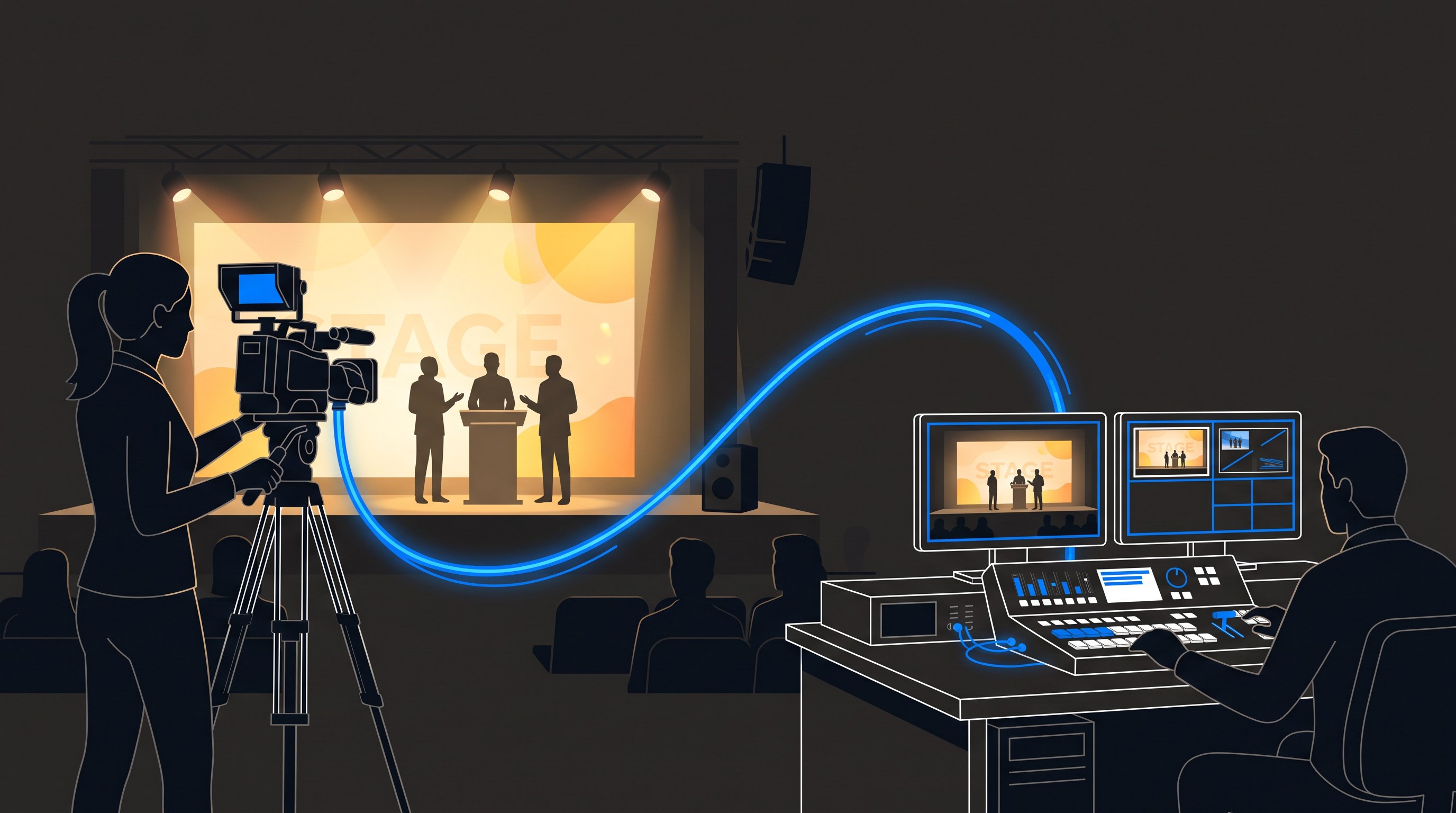
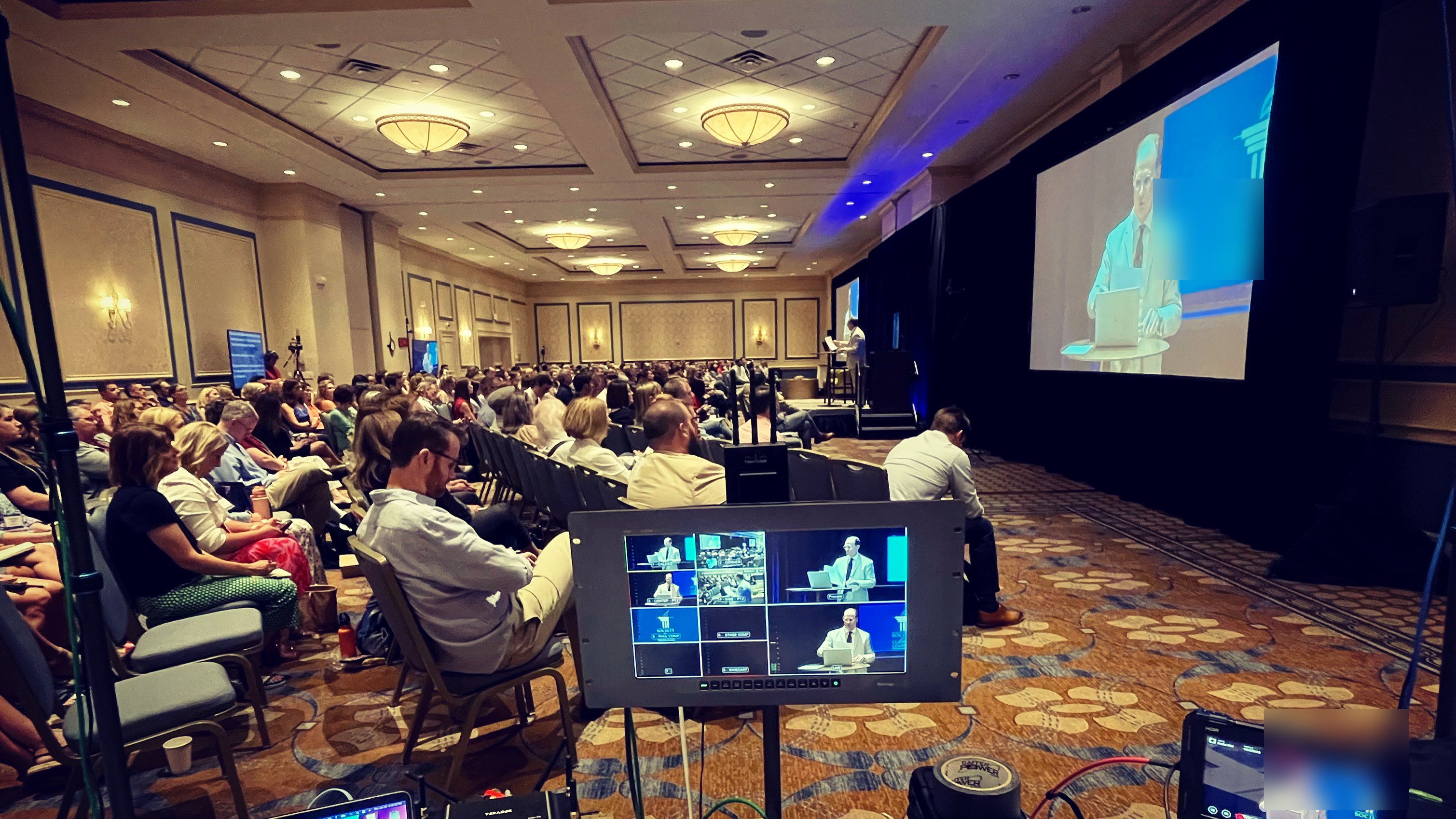
A high-stakes event should look like the moment it is. That means proper cameras, deliberate framing and lighting, clean switching between speakers and slides, and audio so solid nobody thinks about it.
My standard build runs Canon CR-N500 PTZ cameras for clean, controlled angles without a crowd of operators, a Blackmagic ATEM handling the switching, and Sennheiser mics mixed through an Allen & Heath SQ5. The stream rides a LiveU Solo Pro bonded encoder pulling from the venue network and cellular simultaneously, so a single connection failing never reaches your audience. A separate local recording runs the whole time. None of this is visible when it works — which is the product. You're buying the version of the event where nothing went wrong.
Honest ranges: a fully remote produced event — presenters in one controlled location or joining remotely — starts around $1,595. On-site production at your venue with cameras and crew starts around $3,900, and that's where most investor and shareholder events land as a floor.
Add complexity — multiple cameras, an in-room audience plus the remote one, live Q&A or voting — and you're typically between $5,000 and $15,000. Longer sessions in the remote format are quoted based on duration, presenter count and production complexity. I price every event individually because the security and reliability requirements move the number more than the camera count does. For the component-by-component math, here's how much it costs to livestream an event. What I'd push back on is bargain-hunting this particular event: the cost of it going wrong is measured in trust, not dollars.
Two minutes of context gets you an accurate quote and a vendor who plans the right event. Lead with the stakes, not the gear.
Tell them: what the event is and who's watching. How access needs to be controlled — password, registration list, or SSO. Whether it's in-person, remote, or both. Whether there's Q&A or a vote. What happens to the recording and who's allowed to have it. And the date, because high-stakes events benefit from real rehearsal time. If a vendor doesn't ask about access and security early in the conversation, that tells you what kind of events they usually run. If your event leans webinar-shaped instead — registration, marketing goals, external promotion — my produced webinar packages are built for that lane.
If you've got an investor meeting, shareholder call, or major corporate broadcast coming up, grab 20 minutes with me — no pressure, no pitch. Tell me the audience, the access requirements, and the date, and I'll give you a straight answer on approach and cost.
An event webcast is a produced, broadcast-style stream of a single significant event — an investor meeting, shareholder call, or major announcement — delivered live to a controlled remote audience. It's built around production quality, secure access, and reliability rather than open interaction.
Mostly in who can watch and what's at stake. A typical event livestream aims for reach — the more viewers the better. An event webcast usually restricts the audience, controls access tightly, and treats reliability and a clean record as the product. Same broadcast DNA, opposite distribution goals.
The stream lives on a gated player, never a public link. Access runs through a password, a checked registration list, or SSO against your own directory, depending on the audience. There's a record of who got in, and the archive is handled with the same access rules as the live event.
Yes. Moderated Q&A — live audio or written questions read aloud — is standard, and formal votes can be built in when the platform needs to capture them. It's planned as part of the production, not bolted on during the event.
A fully remote produced event starts around $1,595, on-site production at your venue starts around $3,900, and multi-camera or hybrid builds with in-room audiences typically run $5,000 to $15,000. Scope and security requirements move the number more than anything else.
Yes — a high-quality local recording captured independently of the stream, so the archive isn't at the mercy of that day's bandwidth. It's delivered under the same access rules as the live broadcast: private link, gated replay page, or raw file to your team.
A few weeks minimum for a high-stakes event — the access setup, platform testing, and rehearsals are the parts you don't want rushed. For events tied to a fixed date like an annual meeting, earlier is better.
Yes, but I plan them differently — recurring town halls and leadership briefings run as a program with monthly pricing rather than one-off event builds. That's covered in my guide to live webcasting services for corporate meetings.